
A Hit Job with Footnotes
A New Report Gets Anthropology Wrong

By Conrad Phillip Kottak
A commission of eminent scholars recently decided to examine whether politics has corrupted academic scholarship in the humanities and social sciences. Their April 2026 report makes some good points. It also does to anthropology exactly what it accuses bad scholars of doing to knowledge. It cherry-picks.
The report was assembled by Paul Boghossian, Silver Professor of Philosophy at New York University, and submitted to university chancellors alarmed by what they see as the erosion of scholarly standards. The commissioners include philosophers, historians, sociologists, and one biological anthropologist. Their charge: find out whether political commitments have distorted scholarship in the humanities and social sciences.
They get some things right. Their critique of relativism is sound and clearly argued. The self-refutation point is not new, but it lands hard: scholars who claim that all truth is subjective cannot then assert, as fact, that their own position is correct. That is not a subtle point. It should embarrass anyone who misses it. The report also resists calling for right-wing politicization as a cure for left-wing politicization, and it honestly acknowledges the threat from federal overreach, including a documented case of a Texas A&M professor told to remove Plato from his syllabus. Credit where it is due
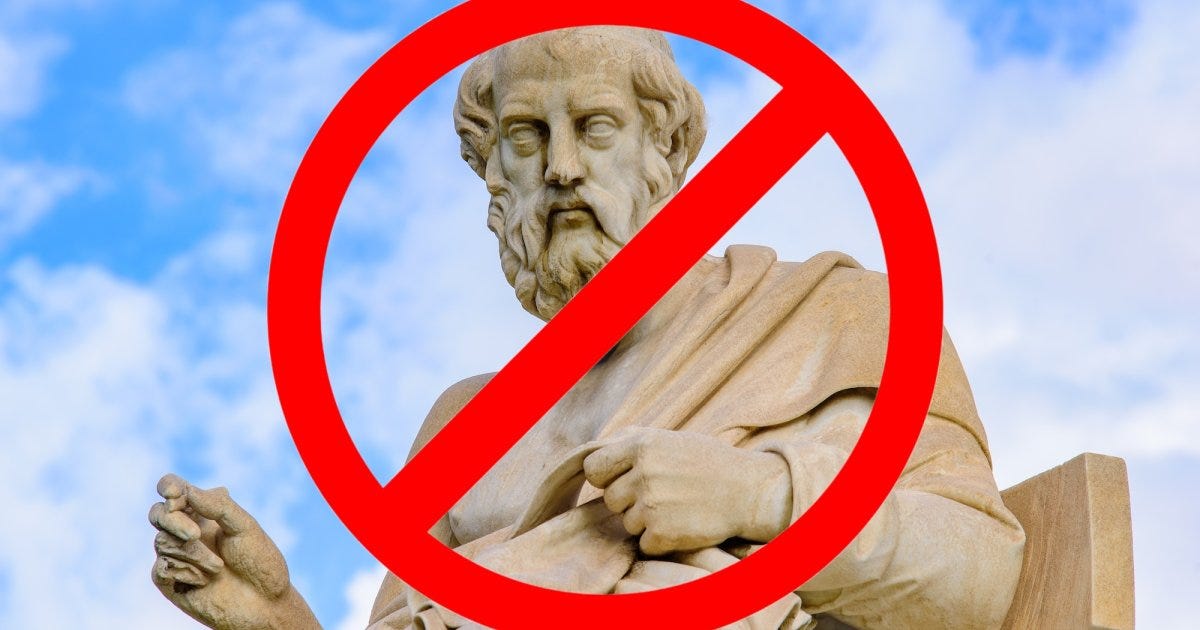
Aggies ban Plato.
Then the report turns to anthropology, and things go wrong.
Anthropology has four subfields: cultural anthropology, anthropological archaeology, biological anthropology, and linguistic anthropology. A general anthropology encompasses all four, along with applied work. The report engages with none of this. Instead, it hunts through the most politically driven corners of cultural anthropology, pulls out the most extreme statements it can find, and presents them as a portrait of the whole discipline. This is the fallacy of citing only positive cases. Prosecutors do this. Scientists are not supposed to.
Look at what gets left out. Biological anthropologists study human evolution, skeletal biology, primatology, and population genetics. Anthropological archaeologists reconstruct past human behavior from material remains. Linguistic anthropologists analyze language structure and variation with methods any empiricist would recognize. And within cultural anthropology itself, systematic fieldwork carried out over months and years in real communities has produced some of the most durable knowledge we have about how humans actually live. I have spent more than sixty years doing exactly that, in Brazil and Madagascar. The National Academy of Sciences does not elect members for writing advocacy pieces. It elects them for doing science. Some of those members are anthropologists.
The report seizes on a statement by Fernando Villanea, published in the American Anthropological Association’s flagship journal: “The core academic value of anthropology is not the pursuit of truth, because all truth is subjective.” Villanea has since said the passage was taken out of context, that his essay was about how anthropology should serve Global South communities. Fair enough to note. But the statement says what it says. You cannot declare, as fact, that there are no facts. It collapses under its own weight regardless of the intention behind it.
What strikes me is that I have heard its equivalent somewhere else entirely.
In earlier writing I described what I called convergent evolution in epistemology. Two very different traditions, traveling completely different roads, have ended up in the same place. Some academic postmodernists, including some cultural anthropologists, spent decades arguing that objectivity is a Western conceit and that facts are socially constructed. The current political environment reached the same conclusion by a different road, not through theory but through the simpler convenience of making reality negotiable when it produces inconvenient results. Kellyanne Conway’s “alternative facts” and Villanea’s claim about subjective truth are structurally the same move. The politics point in opposite directions. The damage to honest inquiry is identical.
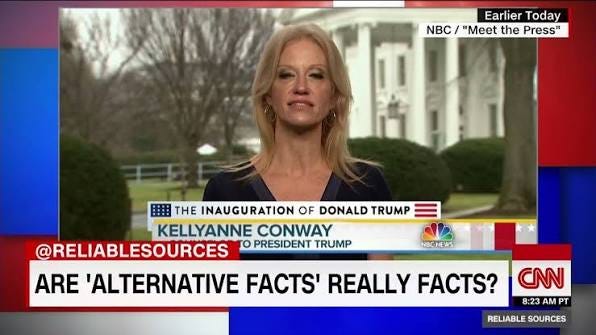
All truth is subjective/Alternative Facts
This is not a left-wing pathology. It is not a right-wing pathology. It is a general pathology, and naming it clearly matters. The Boghossian report spots it on one side and misses it on the other.
Here is something else the report misses. There is a fundamental difference between theory in the scientific sense and theory as practiced in much of contemporary cultural anthropology. Evolution through natural selection is a theory, with natural selection as its core mechanism. It explains the giraffe’s neck, the spread of antibiotic-resistant bacteria, and why we need a new flu shot every year. It was built to explain one set of observations and keeps working on entirely new phenomena nobody anticipated. You can test it. You can extend it. It works.
What passes for theory in postmodernist cultural anthropology works nothing like that. The standard move is to take one of the usual suspects, Michel Foucault, Pierre Bourdieu, and Bruno Latour being prominent among them, borrow a framework, and apply it to a text or a cultural moment as an interpretive lens. It is worth noting that none of these figures was an anthropologist. Foucault was a philosopher and historian, Bourdieu a sociologist, Latour a sociologist and philosopher of science. Cultural anthropology has been importing its theory from neighboring fields rather than building its own. And what it has imported does not predict anything, cannot be tested, and does not extend to new domains the way evolutionary theory extends from finch beaks to flu viruses. It is closer to literary criticism than to science, and calling it theory is generous.
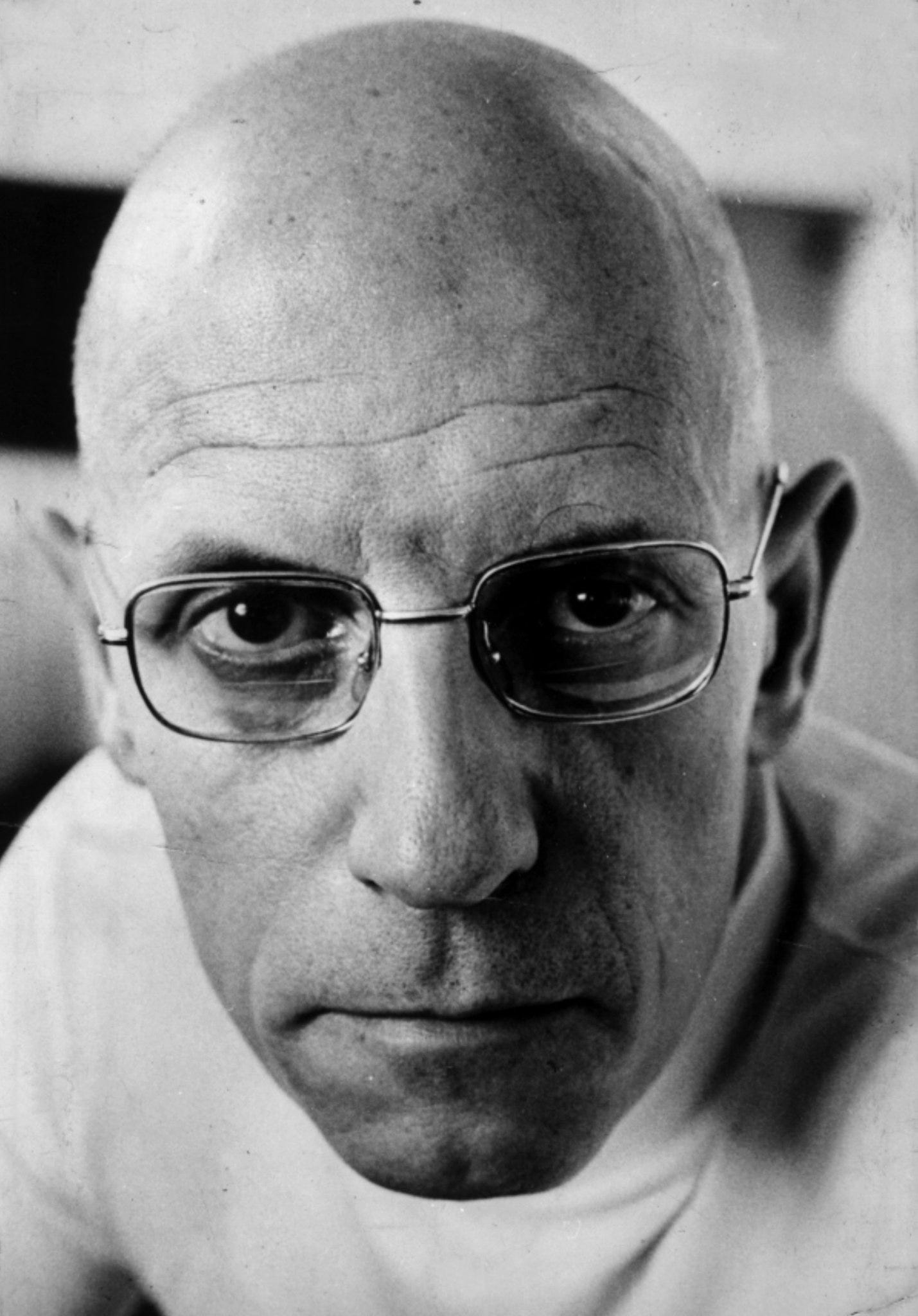
Here’s looking at you, Michel Foucault.
The deeper irony is that anthropology once had real theoretical ambitions. Whatever their weaknesses, cultural evolutionism, structural functionalism, and cultural materialism were genuine attempts to build explanatory frameworks testable against ethnographic data. What replaced much of that tradition in cultural anthropology is not a better theory. It is the abandonment of the theoretical enterprise, dressed up in vocabulary that sounds rigorous without doing the work rigor requires.
The drift of cultural anthropology away from science is real. I have watched it happen over sixty years. That is worth criticizing. But it is not the whole discipline. Treating the worst statements from one corner of one subfield as the face of anthropology is not analysis. It is a hit job with footnotes.
The remedy for bad epistemology has always been the same: careful, honest inquiry, following the evidence wherever it leads. The report argues for exactly that standard. It should have applied it to anthropology.
Good response to this study and Post-Modernism continues to poison Anthropology.
good job. thanks! epd